The counters in the corner are not decoration. Almost every game in this genre runs exactly two currencies with sharply different jobs, and telling them apart makes the economics of the game legible in about a minute.
Soft and hard
The soft currency, usually coins or stars, is earned by playing. It flows in steadily, it is spent on ordinary things, and running out of it is a normal part of the game that solves itself by playing more.
The hard currency, usually gems or a similar premium token, is earned in trickles and bought in bulk. It is spent on the things that bypass constraints: refilling lives, adding moves, skipping a wait. Running out of it does not solve itself by playing, which is exactly the point.
The rule that makes the system work
You can nearly always convert hard into soft, and almost never soft into hard. Gems buy coins; coins do not buy gems. That one-way valve is what keeps the premium currency scarce no matter how much you play, and it is the single most reliable structural feature across the whole genre.
Once you notice it, a lot of otherwise puzzling design decisions become obvious. It is why the generous-looking coin rewards never accumulate into anything that matters, and why the small gem rewards feel disproportionately significant.

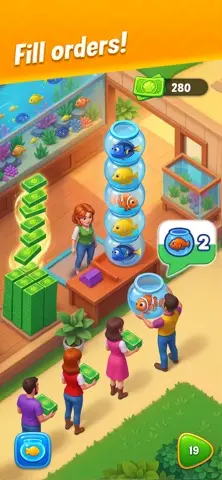

A quick way to read any new game of this type: find which currency refills lives. That one is the hard currency, whatever it is called, and its price list is the real price list of the game.
What soft currency is actually for
It is usually not a constraint at all, but a pacing device dressed as one. Coins are given out freely enough that they rarely block anything, and their function is to make progress feel earned. In games where coins buy renovation tasks, they are effectively a second display of level progress rather than an independent resource.
The practical implication is that hoarding soft currency achieves very little. There is rarely a soft-currency purchase big enough to be worth saving several sessions for, and holding a large balance mostly means you have deferred rewards you could have been enjoying.
Where the pressure sits
Hard currency is where every design decision converges. It refills lives, which is the main constraint. It adds moves at the end of a failed level, which is the moment of maximum frustration. It skips event timers, which is the moment of maximum investment.
All three uses share a property: they are offered when you are already committed, not when you are deciding calmly. That is not an accident, and recognising the pattern is most of the defence against it. An offer that appears at a moment of frustration is one to evaluate later, when the frustration has passed.
Reading the shop honestly
The shop screen makes the economics visible if you look at it as a price list rather than a menu. Two things are worth checking.
- The per-unit rate across pack sizes. Larger packs are cheaper per unit, which is normal retail practice, and it also means the advertised headline price of the small pack is the worst value on the page.
- What the smallest useful action costs. Work out how many gems refill a set of lives, then how many dollars that is. That number, not the pack price, is what the game actually costs to play impatiently.
Doing this once, calmly, for a game you play regularly is genuinely useful. It converts a vague sense that the game wants money into a specific figure you can decide about.
The honest position on spending
Paying for a game you play daily is reasonable, and these are large productions that cost money to make and run. The distinction worth holding on to is between buying something deliberately and buying something reactively. A gem pack bought on a Sunday because you enjoy the game is a purchase. The same pack bought at the end of a failed level with a timer running is a different transaction, and the second one is the one people describe regretting.
Australian purchase controls make the reactive version much harder to do accidentally, which is covered in the guide on rewarded video and consent along with the advertising side of the same economy.